Showing posts with label Reviews. Show all posts

Friday, January 23, 2026

'The Empty Man' an undiscovered horror gem


I do a lot of research on film. I watch quite a few, and I've found that there are a lot of bad genre films out there. Every once in a while, I find a film that's unexpectedly good. Such is the case with
The Empty Man. Here's a review, excerpted from a future book:

The Empty Man

Director: David Prior

Screenwriter: David Prior  

Cinematographer: Anastas Michos  

2020, 137 min.

Finally! An undiscovered gem. This film, the first feature by writer/director David Prior, is a top-notch horror extravaganza that rings the changes on the classic horror tropes and enlivens them with the bold and intelligent visual drive of the narrative.

The film knows its stuff. It’s a killer script. There’s the trapped in a cabin in a blizzard bit, the steamy sauna, the forbidden ritual, the darkened house, the skeptical observer drawn into another, insane world. It treats the typical horror-film situations, but finds a clever and original and engaging to do so. You are kept on your toes with the movie, as it gets weirder and weirder and weider.

After a mind-bending opening in 1995 Bhutan, the film moves to 2018 Missouri, where a former police officer, James Lasombra (meaning, ominously, “the shadow”), played by James Badge Dale, helps a widowed single mother (Marin Ireland) to find her teenaged daughter Amanda (a great Sasha Frolova), who has disappeared. She has left behind only a message, “The Empty Man made me do it”.

Lasombra investigates, and learns the backstory. A bunch of teenagers, hanging out on a rural bridge, recall the legend of the Empty Man, who will come if you stand on the a bridge, blow into an empty bottle, and think of him. The first night you hear him, the second night you see him, the third night he finds you.

Of course, the kids all do it – and then, of course, all hell breaks loose. James goes to the bridge, blows into a bottle himself . . . maybe not the wisest move. He investigates the Pontifex Institute, which proposes that humankind enter a unitary state that wipes out their problems and all their will. An extraordinary lecture given by Arthur Parsons (the great Stephen Root), outlines the beliefs of a sinister cult that denies distinction between right and wrong and preaches slavish devotion.

Root’s recitation of the mind-numbing philosophy he espouses is a brilliant little scene. It implies that there is a “noosphere” containing all consciousness and numerous realities, He urges submission to its domination. These are devils.

Lasombra pursues them, then they pursue him, terrifyingly. The barriers of reality break down in a Cronenberg-like way, and Lasombra finds himself being proposed as the new tulpa, the vessel for the sentience from another world. “We transmit, you receive” is the ominous chant. It’s all quite farfetched and highly enjoyable. It’s compelling. It has internal logic. It’s a darn good film.

Tuesday, December 30, 2025

Book excerpt: from 'Pow! Zoom! Bang!: Comics and the Cinema': 'Wilson' (2017)


Wilson

Ad Hominem Enterprises: 2017

Source: Wilson – Daniel Clowes

Director: Craig Johnson  Producers: Jared Ian Goldman, Mary Jane Skalski  Screenwriter: Daniel Clowes  Cinematographer: Frederick Elmes  Leading Players: Woody Harrelson, Laura Dern, Cheryl Hines

101 min.

This movie is a hidden gem. It’s an old-school comedy odyssey for grown-ups, an excursion into the unique mind of the noted graphic novelist Daniel Clowes, who composed the screenplay as well. Thoroughly enjoyable, its quirky and profane observations on mundane life, and the characters who inhabit it are charming.

Woody Harrelson is here the title character, a befuddled middle-aged flailer at life with no filter whatsoever no family connections, and with exactly one friend (played by the great Brett Gelman, who steals his scene). Wilson is a great character to play, one who distinctively always says exactly what he thinks. This transforms his speech into a kind of offensive poetry. He constantly goes where he is not wanted, physically and mentally.

 His father dies, leaving him his absurdly large paneled station wagon to drive around in. He’s lonely. Only his faithful dog Pepper consoles him. Wilson, a stranger to Internet research, finds out that his ex-wife of 17 years has returned to their town in Minnesota. She, Pippi (Laura Dern) reveals that she did not abort Wilson’s baby all those years ago and that he has a daughter.

Wilson is ecstatic, and he hunts down and barges into his teenaged daughter Claire’s life, dragging Pippi behind him. They establish a weird kind of relationship with the girl (Isabella Arama), who doesn’t know what to make of them. Wilson is energized by the contact . . . but then he blows it all up when he and Pippi take Claire, without her adoptive parents’ permission, to meet Pippi’s mean, perfect suburban sister Polly (Cheryl Hines) and her completely successful family (everyone but Wilson and Pippi is well-off, it seems).

Pippi attacks Polly, the cops come, and Wilson gets three years in jail for kidnapping and child endangerment. Oddly, he perseveres and becomes his best self in prison, befriending everyone. In the blackest of comic observations, the movie says it’s where a soul such as his really fits in.

Pippi leaves him for her Narcotics Anonymous sponsor, and is off to Australia. Released, he goes back to visit the lady who used to dog-sit for him, Shelly (the dependable Judy Greer, who’s made a whopping 179 films) and falls into a romantic relationship with her.

Claire gets back in touch with him, revealing that she is pregnant and moving to Portland. Wison considers moving, but for once in his life makes a smart move and stays where he is. The last image is he and Shelly loving his grandchild via livechat on his computer.

These are comic archetypes. Harrelson and Dern have a ball as Wilson and Pippi. He’s a wandering eccentric; she’s a good-hearted dimwit. Watching them metaphorically sticking their tongues in the light socket, over and over again, is entertaining but heart-rending at the same time. Our lead characters are inane, obtuse, deluded – but we end up rooting for them. It's classic comedy.

Direction Johnson does a great job with a top-notch cast, holding back from the characters ever-so-slightly, quietly watching their akimbo emotions splashing around the landscape, derailing their lives. If there is such a thing as deadpan naturalism, this would be a prime example of it. Wilson resolves itself, redeems its characters, even gives us a happy ending. It’s a kind of pilgrim’s progress.

Friday, August 29, 2025

Lee's 'Highest 2 Lowest' and Kurosawa's 'High and Low'


“Highest 2 Lowest”

Dir: Spike Lee

Scr: Alan Fox

Pho: Matthew Libatique

Ed: Barry Alexander Brown, Allyson C. Johnson

Premiere: Aug. 16, 2025

133 min.


“Tengoku to jigoku (High and Low)”

Dir: Akira Kurosawa

Scr: Hideo Oguni, Ryuzo Kikushima, Eijiro Hisaita, Akira Kurosawa

Pho: Asakasu Nakai, Takao Saito

Ed: Akira Kurosawa

Premiere: March 1, 1963

143 min.

As a speaker noted at the screening of Highest 2 Lowest, this was a project that had floated around America for 35 years. Evidently Spike Lee picked up this screenplay by Alan Fox prior to COVID liked it, held onto it, and reworked it after he got Denzel Washington to star as the stressed-out music exec threatened by a kidnapper.

Looking at Lee’s vision, it’s interesting to watch him choose to be expansive and inclusive in his approach to the film, crafting many different films in one. (His repertoire of film styles within include homemovies, fanciful wipes, and documentary-like snippets.) Where Kurosawa, austere in black and white, was reductive and quiet in High and Low, Lee makes Highest 2 Lowest open out, awash in color and enchanting images, and makes music a major part of the action, even providing a musical coda that underlines the redemption of the central character, David King (Washington).

The source in both cases is Evan Hunter writing as Ed McBain’s 1959 police thriller, King’s Ransom. For both Kurosawa and Lee, it is a study in character that asks important questions about honor, compassion, and justice. (Kurosawa’s Japanese title is literally Heaven and Hell.)

King lives high in a penthouse looking spectacularly over the Brooklyn Bridge and the approach to Manhattan. He’s a hitmaker, a colossal figure in the music business who’s orchestrating a deal to take over his record company.

Suddenly, a call comes in. His teenage son has been kidnapped. The kidnapper wants $17.5 million in Swiss francs. The Kings, father and mother, go berserk. Then their son appears. It was not he but his best friend, the son of King’s chauffeur, Paul Christopher (a brilliant Jeffrey Wright), who the kidnapper snatched.

The kidnapper calls back. He doesn’t care who he has, he wants the money or the kid will die. Will King give up all his assets for the life of another man’s son?

The same close examination of character takes place in the Kurosawa film. Here, the shoe tycoon Gondo (another great performance from Toshiro Mifune) and company float around their hilltop mansion, pondering and debating what to do about the kidnapped child of his chauffeur. Shooting in 70 millimeter, Kurosawa builds carefully balanced compositions out of the attitudes of the actors present, shifting in patterns and keeping Gondo on the opposite side of the screen from his interlocutors, like some modern-day Job.

The films match each other in a general sense, following the same course of action. Each man is told that he will be reviled personally and professionally if he does not pay up. Mifune and Washington both face their demons. Both performers are quite capable of communicating the moral quandry they find themselves in.

Once Lee’s mogul decides to pay the ransom, the film opens out and becomes a veritable travelogue of New York City. There is even time for the buffoonish police force to get entangled in a concert by the late Eddie Palmieri and his Orchestra. An intricate game of cat and mouse plays out on the city streets, but the bad guys get away.

Then Lee lets the action take another turn. King remembers that the kidnapped young man had heard an incessant rap refrain during his captivity. King matches it with a mix an aspiring rapper sent to him. He and Christopher, ignored by the police, track the suspect down on their own. Now we are in action-film territory. Denzel runs the suspect down, hears his confession (ASAP Rocky plays the strapped, weed-smoking kidnapper), chases him all over town, gets on the subway – hilariously, Lee gives rabid Yankee fans a chance to look into the camera and chant “BOSTON SUCKS!” -- gives him a beat-down, and saves the day.

Kurosawa also gets away from his chamber drama after the ransom is pledged. His film turns into a straight-ahead police prodecural. Gondo makes the drop, and the police force begins a coordinated investigation into the crime, marshaling a large contingent of specialists who analyze the scant information given to them and extrapolate who the kidnapper and killer is. In contrast with Lee’s lone-hero approach, in Kurosawa success is seen as the product of a professional, joint effort.

King’s outcome, redemption and the restoration of his fortune, stands in sharp contrast to Kurosawa’s Gondo, who loses everything. Kurosawa’s villain is a triple murderer; Lee’s villain is a misguided wanna-be. Both stare up at the successful businessmen living high above them; both boil in the summer heat of the slums. Both present themselves as worthy matchers of wits; both are deluded.

“Not all money is good money,” says King. Both Kurosawa’s and Lee’s protagonists realize their true value in the heat of the moment. Though their outcomes differ, their quiet return to life underscores their new state of peace. Gondo’s kidnapper, facing death, breaks into a tortured shriek, and a metal grate comes clanging down, ending the film; Lee’s villain merely curses out the obdurate King. In the compelling dialogues the protagonist has with his opponent, he outlines the difference in their essential characters, the juxtaposition of the older, saner man and the young hothead. Then we get the redemptive ending.

Kurosawa is edgy, unbalanced. Right wins out, but the disturbing and abrupt ending asks questions it has no intention of answering about sanity and morality. It resonates. With Lee, the alert and engaged hero outfoxes and outfights his opponent, and lives to make music another day. It’s an oddly Hollywood ending, but by this time the film had been a lot of things: a moral drama, an epic chase, an action thriller, a musical. Lee makes room for what he wants.

Lee’s is, ultimately, another great New York movie. His love for the city is obvious, and he makes the most of the territory. His performers are expert, his eye unfailing. He gives us a man redeemed. Kurosawa’s is a more tragic classic.

Monday, July 14, 2025

Review: 'Superman' (2025)


Superman

Dir: James Gunn

Prod: Peter Safran, James Gunn

Scr: James Gunn

Pho: Henry Braham 

Leading Players: David Corenswet, Rachael Brosnahan, Nicholas Hoult

129 min.

Superman has a dog.

If this seems odd to you, it’s probably because you were raised on the gentle and subdued Christopher Reeve in the super-role, or Henry Cavill’s forbidding seriousness. This is neither of those. It’s all part of a desperate attempt by the DC film studio to reboot their unsuccessful rollout of a DC Extended Universe, which faced diminishing returns in recent years.

Fortunately, they called on writer/director James Gunn to work his magic. Gunn, who created the wildly popular Guardians of the Galaxy trilogy, as well as 2021’s successful adaptation of DC’s The Suicide Squad. Gunn knows his comics inside and out, and it shows.

This super-story doesn’t go back over our hero’s unique origin. We are initially given Superman at his lowest ebb, defeated and injured. This is a vulnerable Superman, a relatable and imperfect character that is given life by the excellent David Corenswet. He is still using the persona of Clark Kent, mild-mannered reporter for the Daily Planet. He is in a relationship with hotshot journalist Lois Lane (Rachel Brosnahan), who in this film knows all about his secret identity.

But Superman has an enemy. The bald, evil billionaire Lex Luthor (Nicholas Hoult) hates Superman, and seeks to destroy him by any means necessary. He invades his Fortress of Solitude, hacks into his database, and recovers a fragmented message from Superman’s Kryptonian parents – one that makes Superman question his identity and mission.

And he kidnaps Superman’s super-dog, Krypto. The Man of Steel having a pet humanizes him. Corenswet plays him like a regular guy with a big responsibility, instead of some kind of messiah. He leads with his humility, and that makes his performance the more appealing.

The production design is bright and primary-colored, better reflecting the movie’s comic book origins. The action sequences are well-staged, and moments of banter and the necessary snatches of exposition are integrated seamlessly into the film. Subsidiary characters – an obnoxious Green Lantern, Hawkgirl, Mr. Terrific, and Metamorpho – are rendered in three dimensions and given their due. Importantly, Hoult’s Luthor is completely credible – not played with the sly wit of Gene Hackman, but grounded in an earnest thirst for power and control.

When all is said and done, the result is satisfying and affirmative. This Superman is a fun adventure for kids of all ages.

Monday, December 9, 2024

Character study: 'A Real Pain'


A Real Pain

Dir: Jesse Eisenberg

Scr: Jesse Eisenberg

Pho: Michal Dymek

Ed: Robert Nassau

Premiere: Nov. 1, 2024

90 min.

Jesse Eisenberg is a familiar face on screen. His nervous, stuttering persona has graced many movies, including The Social Network and Zombieland. However, he’s an aspiring screenwriter and director as well. A Real Pain is his most effective effort to date.

It’s the story of two cousins, the uptight Eisenberg and Kieran Culkin, whose character is a hodgepodge of strong feelings, earnestly expressed. They were raised together almost as brothers, so their reunion after what seems to have been a few years is a study in what changes and what does not change in people as they grow older.

The cousins are on a vacation together, if you can call it that. They are touring the concentration camps in Poland. This somber journey is punctuated by the incessant irritation of Eisenberg, who can’t handle the exuberant informality of Culkin’s character. It’s a movie full of quirky humor, that works despite the very serious backdrop to it all.

In the end, Eisenberg gives us no great revelations, no climactic incident. People are who they are, he seems to be saying, in many ways immutable. The grace that comes with accepting that is an aspect of growing up not often paid attention to. Eisenberg gives us an artfully crafted description of that.

Sunday, December 8, 2024

For adults only: 'Anora'


For adults only: ‘Anora’


Anora

Dir: Sean Baker

Scr: Sean Baker

Pho: Drew Daniels

Ed: Sean Baker

Premiere: Oct. 18, 2024

139 min.

Sean Baker’s feature Anora is strictly for adults. Why? First, because it contains a lot of frankly sexual content. Secondly, and more important, it deals with grown-up reality, which will be much more a deal-breaker for potential viewers than the sex part.

Baker, best known for his The Florida Project (2017), makes movies about people dwelling at the edges of the American dream. Here he picks up the tale of a young stripper of the title, played most excellently by Mikey Madison. She works in New York, and because she can speak Russian, she is tapped to entertain Vanya, the wasted young son of a Russian oligarch.

The two get along, and soon Vanka is paying “Ani” for a week of pretending to be his girlfriend. Then he proposes marriage in Vegas. They get hitched . . . and soon the parents find out. It turns out that Vanya would like a green card, so that he doesn’t have to go home and work for his father. Vanya’s mother races to New York, insisting that the marriage be annulled.

Ani gets swept up in all this due to an ironic naivete that doesn’t travel well with the explicit sex work she specializes in. She is an expert at being desirable; marriage to a rich man could easily be seen as the ultimate goal of a woman in her profession. She gets what she dreamed of, but it quickly and shoddily falls apart. It’s only when the dreams are broken that we see begin to perceive Ani’s great and unexpected strengths.

This is a Cinderella story, albeit one that ends seemingly unhappily. It’s also a refutation of Pretty Woman, which I am always up for.

Whoever’s in power decided to not promote this film! Have you ever heard of it before today? I only saw it by sheer chance. The sexual content is almost all at the front of the movie, and it is so in your face that for a while I considered the idea that this was the wrong kind of film to watch. I can imagine it was a nightmare for marketers to try and think how to sell this film. But that’s because Baker tells real stories about believable people, interesting characters that go through life-changing experiences, for better and for worse.

So, if you are a mature and thoughtful adult, I highly recommend this comedy of manners for the 21st century, which turns out far more poignantly than you might expect.

Sunday, October 8, 2023

'She Came to Me': A movie for grown-ups


 She Came to Me

Dir: Rebecca Miller

Scr: Rebecca Miller yeah

Pho: Sam Levy

Ed: Sabine Hoffman

102 min.

These days, films are all too easily shoved into slots of genre, their edges beveled down smoothly. The formulaic blockbusters of today resemble nothing so much as well-oiled machines, without quirk or reflection. This is not a new development: there have always been less than challenging films out there, films designed by large crews of people to appeal to the broadest possible audience.

Then there are the independent films. Films not adapted from another medium. Films made because they are works that can only be made as a film. Such a one is the rare treat from writer and director Rebecca Miller, She Came to Me. It’s a lovely throwback to the Silver Age of American cinema (1967-1977), when studios took chances on idiosyncratic, personal movies, without gimmicks, bells, or whistles, that actually found interested viewers.

It is doubtful this film will make a lot of money. It wasn’t advertised at all, as far as I can tell. Somehow Miller wielded some clout to get this made, and I’m glad she did. She has created a lively yet understated comic universe filled with interesting characters that travel through a completely unpredictable plot. In other words, a STORY. What a concept!

She attracted top-notch talent to the project. Peter Dinklage stands at the center of the film, in the hilarious role of a hang-dog opera composer who’s got a creative block. He is married to his former therapist (Anne Hathaway, who really gets a fun character to work with), and he miserably gets through each day with her therapeutic assistance.

Cajoled into taking a walk by his wife, the composer stops in a bar and runs into a female tugboat captain with attachment issues (Marissa Tomei, also great). What follows has little logic on the outside, but the film’s emotional logic is impeccable, as everyone caroms off each other, sending each other into entirely unfamiliar new trajectories.

There are no heroes or villains in the piece (OK, maybe Brian D’Arcy as a controlling husband and stepfather is the boogeyman the piece needs to propel its plot). There are no overwhelming moments of action-packed adventure, no fist-pumping affirmations. It’s simply an amusing and involving tale of real people in complex situations, and as such is a completely enjoyable experience.

I challenge you. If you can really digest grown-up fare, watch this movie. It will reward you deeply, not least through the fact that it proves that movies like this can still be made, and still can find appreciative audiences.

Monday, June 19, 2023

'The Flash': Much ado about what was that again?


The Flash

Dir: Andy Muschietti

Scr: Christina Hodson

Pho: Henry Braham

Ed: Jason Ballantine, Paul Machliss

Premiere: June 16, 2023

144 min.

Everyone would like to go back and fix the past. That’s just what Barry Allen (the reputationally beleaguered Ezra Miller) does in his first and presumably his last stand-alone feature as the speedy superhero in The Flash.

It’s also something that’s occurred in the DC superhero-movie universe, time and time again – a second-guessing, a reconsideration of the final product through expanded “Ultimate Edition”s and directors’ cuts in an attempt to please fans, and gain additional revenue on the way.

The Flash is the next-to-last entry in the now-abandoned DC Extended Universe model of interrelated films (coming up later this year: Aquaman and the Lost Kingdom), which commenced with Man of Steel in 2013, and is popularly referred to as “the Snyderverse,” after director/producer Zach Snyder, whose vision had led the way with entries such as Batman v Superman: Dawn of Justice and Justice League. Now James Gunn, director of the successful Guardians of the Galaxy trilogy for Marvel, and DC’s funny, gory The Suicide Squad, is in charge of things at DC studios and is planning a new series of films even as we speak.

But enough exposition. How’s the film? It’s fairly entertaining, though as is the case with many DC films, it is too long and the CGI has its weak moments. That’s too bad, because this movie really leans on incorporating (spoiler alert!) all manner of alternate time-line Batmans and Supermans into the climax, unleashing a torrent of visual effects that feels like someone trying to push all the keys and pedals of a massive pipe organ.

In the film, the Flash discovers that he can run so fast that he can travel through time (stay with me). His father is imprisoned for his mother’s death, and he wants to go back in time and prevent her murder, or at least exonerate his dad. He succeeds, but in doing so changes reality, past and present, and leaves the Earth open to destruction. He must quickly (of course) round up his own version of the Justice League to try to deal with General Zod, Superman’s Kryptonian opponent on Man of Steel, who was killed trying to conquer Earth in that film.

The movie lives or dies on the effectiveness of its central character, and Ezra Miller does a decent job in his role as the Scarlet Speedster. He handles goofy and confused quite well, but has his problems with darker emotions such as anger and sadness (beware: there is copious weeping in this movie). His work is interesting, but ultimately too lightweight for the more serious underpinnings of the story.

Ben Affleck is back at Batman. But wait! Other Batmans lurk here too, and Michael Keaton kinds of dials it in as alternative-timeline Caped Crusader, one that’s retired into a life of eccentric reclusiveness. Will Flash shake him out of his stupor? What do you think?

Michael Shannon reemerges as Zod, and is given little to do save look menacing and make pronouncements. Jeremy Irons is there in a blink-and-you’ll-miss-it as Alfred, Bruce Wayne’s faithful servant.

In the end, The Flash is a moderately interesting superhero flick, a standard-gauge genre film that fills in all the blanks in the schematic of how a superhero movie is made. It tries to have fun but bogs down in its self-indulgent conclusion. For those of us who love or study superhero films, there are more questions. Will DC ever stop messing up and redoing their increasingly unsuccessful releases? Can James Gunn right the ship? Will the audience put up with it?


Wednesday, February 1, 2023

'M3gan': Devil doll


M3gan

Dir: Gerard Johnstone

Scr: Akela Cooper, James Wan

Pho: Peter McCaffrey, Simon Raby

Ed: Jeff McEvoy

Premiere: Jan. 6, 2023

102 min.

In the movies, dolls are inherently creepy, and robots are usually threatening. How much fun it is to slap the two film memes together and see what happens!

In this “post-horror” age, when the genre is plagued with slow places and myriad ambiguities, it’s refreshing to find a good old-fashioned horror movie that’s brisk, focused, and to the point, with a relishable villain. M3gan is a darkly comic disquisition on the dangers of technology that’s immensely entertaining.

The story: little Cady (Violet McGraw) loses both her parents in an auto accident, and goes to live with her aunt Gemma (Allison Williams), an eccentric inventor. Gemma creates interactive, robotic toys, and is tasked by her abusive, pushy boss to create the Next Big Thing. The result is M3gan, a robotic doll that is self-aware and can evolve on its own.

She is created as a companion for Cady, and tasked with protecting her from physical and emotional harm. Gemma is pretty hopeless as a parent, and M3gan fills in as a companion and support system. Unfortunately for everyone, M3gan takes her duties very seriously. She has the mind of a supercomputer, and very little tolerance for moral parameters.

To tell more is to spoil the fun, but be assured that M3gan’s responses to threat rachet slowly higher and higher to and past the point of absurdity. The film’s premise comes in part from horror maven James Wan (Saw, Insidious, The Conjuring), and his sure horror hand is in evidence here. Director Johnstone tells the story with a minimum of fuss, and keeps the humor understated and steady throughout. The action is toned down to PG-13 level, with no graphic shocks and only the occasional jump scare.

The real appeal is watching M3gan become self-aware, and the bad choices that follow. In moviedom, M3gan has laready become an icon of sorts, perfect on the outside and completely messed up within. She’s not only a killer, she’s a killer app.

Friday, January 27, 2023

The NFR Project: 'Grass: A Nation's Battle for Life'


Grass: A Nation’s Battle for Life

Dir: Merian C. Cooper and Ernest Schoedsack

Scr: Terry Ramsaye

Pho: Merian C. Cooper, Ernest Schoedsack, and Marguerite Harrison

Ed: Terry Ramsaye, Richard P. Carver

Premiere: March 20, 1925

71 min.

Grass: A Nation’s Battle for Life is one of the most extraordinary records ever put on film. It captures a way of life thousands of years old, before modern technology eliminated it. The second important ethnographic documentary to be released, after Robert Flaherty’s 1922 Nanook of the North, it vividly illustrates film’s ability to bring us sights we might otherwise have never seen, lost to history forever.

Merian C. Cooper was a journalist and explorer. Ernest Schoedsack was an adventurous cameraman. Marguerite Harrison was a journalist and part-time spy for the U.S. Together, they conceived of making a documentary about Kurdish tribes in Turkey, but when they got there they found the prospect wasn’t as photogenic as they had hoped. Casting about for a subject, they came upon word of the Bakhtiari people of southeastern Iran. After an interminable journey across Turkey and Arabia, and after much negotiation, the three were allowed to accompany the Baba Ahmedi tribe on their yearly migration.

The tribe, consisting of 50,000 members, and trailing half a million horses, cattle, goats, and sheep, made the trip from the withered grasslessness of valley summer to the high plains of the mountains every year – a 48-day journey that involved crossing a half-mile-wide river and ascending a 12,000-foot mountain range. The grueling migration kept the flocks and herds in fodder year-round.

The film traces this journey. The sights becoming more and more impressive as the film goes on. To cross the River Karun, the tribesmen must create rafts held up by inflated goat skins, and ferry their livestock and all their possessions from one bank to another, a process taking six full days. The extreme peril undergone by all involved is astonishing. After this comes a climb over the mountains, through thick snow, to mountain pasturage. The Bakhtiari hack a path through the snow with picks and shovels; the tribe makes its way over the crest in bare feet.

All the camerawork is incredible – night shots, early in the film, are Rembrandtian, and the rest is carefully framed and observed. (The intertitles are jokey and condescending.) One particular shot, of thousands on the march from the mountain pass to the plains below, stretching away for miles, would not be equaled until the revelation of Wadi Rum in Lawrence of Arabia.

The incredible hardiness of the nomads is on clear display here; it is difficult to conceive of a life lived so close to nature. Undoubtedly, they would not be pastoralists unless necessity made them so. Cooper and Shoedsack later considered a sequel to this film, but by that time rail lines and roads had come into existence, making the Bakhtiaris’ travels much easier. By and by, their migrations have lessened, become more streamlined. With the amount of connection and advances, it is difficult to conceive of a nomadic lifestyle persisting as recently as 100 years ago. Cooper and Schoedsack preserved it for us. It is still compulsively watchable.

What did they do for an encore? They made King Kong.

The NFR is one writer’s attempt to review all the films listed in the National Film Registry in chronological order. Next time: ‘Lady Windermere’s Fan.'


Friday, January 13, 2023

'Avatar: The Way of Water': Splashy


Avatar: the Way of Water

Dir: James Cameron

Scr: James Cameron, Rick Jaffa, Amanda Silver, Josh Friedman, Shane Salerno

Pho: Russell Carpenter

Ed: David Brenner, James Cameron, John Refoua, Stephen E. Rivkin

Premiere: Dec. 16, 2022

192 min.


James Cameron is driven. He makes film spectaculars, and he keeps topping himself -- and everyone else in the industry -- with his new and fanciful creations. The Terminator, Aliens, The Abyss, Terminator 2, Titanic, Avatar. One record-breaking event after another. He seems compelled to create, literally, a new filmic landscape with each new project. We have waited for 12 years to see what’s on his mind now.


Technically, it’s a whole new ball game. Most impressively, he shoots much of his film underwater, and does so as fluently as he films above the surface. He then retools that reality with his amazing use of CGI and what must be the most advanced visual effects department in the world, crafting a new and complete ecosystem, rendered down to the most exacting details. In that sense, it is perfection itself.


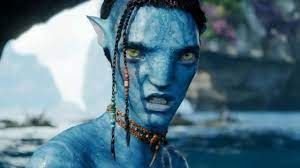
This is a classic fantasy epic. That being said, it is one whose plot and themes a retread of previous Cameron narratives. We are once again on the beautiful, unspoiled planet of Pandora, inhabited by giant, blue, tailed, super-hippie indigenous people called the Na’vi. These noble savages (it is easy to conceive of it as Dances with Wolves in outer space) are uniquely attuned to the natural world, and interact with it in perfect symbiotic harmony.


Until the %#$*(% humans show up. Yes, they’re back, and this time they’re not after Unobtanium, they’re here to colonize Pandora to escape the dying Earth. Yes, we Homo sapiens are the villains, and Cameron’s contempt for humanity was never clearer. He is agonized about our inability to stop contributing to our own environmental destruction, and The Way of Water is very much a plea on behalf of the Earth, in cosmic trappings.


The hero of the last film, human-turned-Na’vi Jake Sully (Sam Worthington), is now a father and tribal leader. Conveniently, the evil Col. Quaritch (Stephen Lang), Jake’s nemesis, has been reborn as a Na’vi avatar as well, and he loses no time in going after Jake, the head of resistance to the human incursion. This quest for vengeance defines the rest of the film. Even the benign Dr. Grace Augustine (Sigourney Weaver) returns, in altered form.


A flight from the dangers of being hunted leads them far away from their homeland, to another tribe that lives in sync with the ocean. What follows is about an hour of illustrating the created environment, leisuring in its wonders like a troop of travelogue-struck tourists. This guided tour of the oceanic life of Pandora does little to advance the plot, but it gives us a lot to look at and to ponder.


Did I mention the magical psychic whales? There’s plenty of them. You see, they’re being hunted, illegally, as they produce a substance that stops aging (a new Unobtanium, if you will). It is this hunt and its thwarting that take up the last third of the movie, propelling us along in a fast-paced, back-and-forth manner (how often can those kids get captured? In that way, it’s remindful of Peter Pan, with Quaritch as Captain Hook.) 


So the whales and the Na’vi and the humans get it on, and it all winds up as you might expect. 


So is it worth it? At three hours, the extreme vividness of the experience tends to overwhelm. It floods the senses, makes it hard to maintain focus. The middle third of the film is a stroll through visual effects. The cliche “kill your darlings” applies here. There is no one to tell Cameron if he’s gone overboard in the world-building department. His tenacious, exacting manifestation of the results of his imagination is an amazing sight. 


Those looking for a new narrative experience will be disappointed. Stick around for the visuals.


Tuesday, January 10, 2023

A bleeding-heart liberal's guide to 'Top Gun: Maverick'


 Top Gun: Maverick

Dir: Joseph Kosinski

Scr: Ehren Kruger, Eric Warren Singer, Christopher McQuarrie

Phot: Claudio Miranda

Ed: Eddie Hamilton

Premiere: May 27, 2022

130 min.

 Hoo boy. Well, it’s a good thing I waited this long to see and review this movie. That’s because it’s critic-proof. Not that many critics disliked it. In fact, pretty much everybody loved this movie. Predictably, I didn’t. Why?

First, I am immune to the charms of Tom Cruise. We are about the same age, and I grew up with his movies. But somehow, his earnest and cocky persona didn’t cause that kind of affection and admiration in me that I feel for the great white male stars from earlier years. I know intellectually that he has the stuff of which leading men are made, but I don’t feel it.

Now he mints his greatest financial win with this film, a sequel to the original Top Gun from 1986. It’s a new and improved product, engineered precisely to evoke heart-pounding, fist-pumping ecstasy in the viewer. And, if you are a male ages 13-18, I guarantee this will provoke that.

But what if you’re older and simply have given up on the glorification of the military and the assertion of the righteousness of violence? If that’s true, then there’ nothing in this film for you. If you don’t accept Captain Pete “Maverick” Mitchell as the World’s Greatest White Man, this film will be an empty exercise in action virtuosity.

You see, Mitchell is still a rebel, 36 years after the first film. He’s also still only a captain, when his friend “Iceman” (Val Kilmer) has by now become an admiral. Why? Because he’s a rebel, dang it! He gets in trouble all the time, and Iceman saves his bacon. This time, he’s the pilot of a experimental craft, and by golly he flies even though he’s told not to, and then flies it faster than it’s supposed to go, so it breaks and apart and he bails out. What a man.

So, do we see this character as an emotionally retarded man-child, struck in Oppositional defiant disorder? No, we see him as the apogee of male aspiration – free, irresponsible, disturbingly ageless. He indeed possesses the biggest penis in the universe.

He is reassigned to his old combat school, the Top Gun of the title. Now he has to pull together a ragtag assemblage of earnest and cocky youngsters who yearn to be schooled in the Tom Cruise academy of rule-breaking charm.

It turns out they have to attack a foreign uranium-enriching plant, run by a country that shall remain nameless (rhymes with Schmiran). This righteous task is a deadly trip through a winding canyon, bordered by missiles, protected by enemy fighters, with a minimal chance of success and no margin for error! It’s basically the final sequence of Star Wars, with Cruise as Luke Skywalker.

That’s right! Little old Tom Cruise goes from coaching the jet jockeys to getting back into the game, leading the mission himself. WHOOSH! BAM! BOOM! What do you think happens? What we would all like to have happen. Then there’s another climax! And another!

Wow. Smoke a cigarette and calm down. What else? The homoerotic sublimation is there in spades, so there’s that. There’s Val Kilmer, the same age as Cruise, looking old enough to be his grandfather. There’s the typical hard-bodies-on-the-beach scene, the meditative motorcycle ride, the second chance with an old flame. All the biggest hits are there, strung like beads on a wire.

It’s a triumph of the industrial cinema. It is wired to stimulate your pleasure zones. Unless you are like me, in which case you’ll go back to watching your weird old foreign art films.


Thursday, January 5, 2023

'The Menu': horror comedy skewers haute cuisine


 The Menu

Dir: Mark Mylod

Scr: Seth Reiss and Will Tracy

Phot: Peter Deming

Ed: Christopher Tellifsen

Premiere: Nov. 18, 2022

106 min.

If you have ever been in a food service job, you will get it. If you’ve ever been to a fancy dinner where you didn’t understand what was going on, you will get it. The Menu is a dark satire that takes on the ridiculousness of high-profile fine-dining experiences, but its tale of madness and obsession is familiar both to those who dish it out and those who take it.

Taking it is, in fact, what the diners of The Menu must do, in ways they’ve never taken it before. Several super-wealthy patrons take a boat to a private island, where they will enjoy a multicourse meal prepared by the quietly remote master chef Julian Slowik (Ralph Fiennes at his icy best). Slowick is king of his world, a master chef whose every command is obeyed by his homogenous staff.

The guests consist of a wealthy couple, a washed-up movie star and his personal assistant, some crypto bros, a critic and her editor, and an obnoxious foodie (Nicholas Hoult) and his paid escort, Margot (Anya Taylor-Joy, who is in everything so why not in this as well?). Slowick’s mother quietly drinks herself to sleep in the corner.

As the meal progresses, the courses get stranger. Chef talks about his impoverished and abused childhood. The maître d, Elsa (Hong Chau), starts abusing the guests. All the while, a sprightly sommelier continues to ply everyone with the appropriate accompanying wine. A sous chef performs a staged suicide.

Then it gets weird.

The filmmakers exercised due diligence in making the film look as convincing as possible – hiring food designer Dominique Crenn and using second unit director David Gelb, who created the Chef’s Table TV docuseries, to make the tone of the film conform to that of the high-end food show. The Menu’s restaurant is all too familiar, an intimidating high-tech, uneaseful space that emphasizes the dominance of the adjoining kitchen.

 The players all maintain straight faces as the carnage begins, and the filmmakers play it straight, too, never tipping their hand or getting ahead of the audience. The airy ridiculousness of fine dining’s conceits and conceptions are skewered thoroughly here.

As the evening unfolds, a laundry list of woes peculiar to the restaurant business are recited – the ingratitude for the effort and energy put into creating nourishing entertainments, the stubborn whims of the customer, who must always be accommodated, the dependence on other peoples' money, the lack of a real life in the business. The NO SUBSTITUTIONS policy. Any cook or server who ever dealt with a recalcitrant patron will savor the various punishments meted out to the assembled customers.

In the end, it’s the pumpers versus the dumpers, and everyone collaborates in their own destruction, save for the cynical and resourceful Margot, who serves as the Ishmael of this fishy tale. An ominous joke of a film, The Menu masterfully deconstructs the curious carapace of conceptions we have constructed around the simple act of eating food.


Tuesday, January 3, 2023

'Cinema Speculation': Tarentino's love letter to movies


Cinema Speculation

Quentin Tarentino

New York: Harper

2022

Here’s what happened. I picked up this book, and read it all the way through, without stopping. That’s the highest recommendation I can give.

This excellent set of essays on film history and aesthetics is the first non-fiction work from director Quentin Tarentino. I am a fan of his work, but not a blindly unquestioning one. So it’s not just a worshipful gushing I give when I say this is the most engaging book about film I have read in a quite a while.

First and foremost, Tarentino writes in what has been called a “conversational and amusing” style. He’s not a stuffy film scholar. Neither is he an arrogant and jaded film professional. Instead, he proves here that he’s still one of us – a regular guy who happens to love movies.

His excitement is infectious. He gives us a childhood in movies watched, takes us on a guided of tour of some of his favorite genre films, and takes a look at the waves of the New American Cinema. He doesn’t like Truffaut, but I forgive him.

It helps immensely that he is of my generation, born three years earlier than me. The films he references watching as he grew up burst immediately to bloom in the minds of any contemporaneous readers. (I spent much unsupervised time at the cinema growing up.) Hey, he hates and fears Bambi, too! And FINALLY, thanks to him I understand the difference between the Dead End Kids, the East Side Kids, the Little Tough Guys, and the Bowery Boys! Who knew?

Tarentino starts by giving us a look at his childhood, one spent most impressionably in movie theaters, watching films not really for children (Dirty Harry? The Outfit? Black Gunn?). His penchant for creating dramas of vengeance undoubtedly stems from early exposure to grindhouse fare. Cinema Speculation is precisely that – an expansive and entertaining discussion of the glories of movies (that’s movies, not cinema).

Best of all, in a tribute to second-string L.A. Times film critic Kevin Thomas, Tarentino praises his optimistic, open-minded approach to writing on movies, and even cites his opinions as being influential in practical choices Tarentino made in making his own films. This affirmation of the critical role in the movie process is tremendously heartening.

Like the film writing he admires, Tarentino’s essays are straightforward, unaffected, and compelling. Whether you appreciate his insights or not, his book is a good time.

Wednesday, November 30, 2022

'Glass Onion': Another entertaining mystery


Glass Onion: A Knives Out Mystery

Dir: Rian Johnson

Scr: Rian Johnson

Phot: Steve Yedlin

Ed: Bob Ducsay

Premiere: Nov. 23, 2022

139 min.

Who can explain the sudden popularity of the murder mystery? Perhaps it was the pandemic, which led some to binge on the pleasures of Christie, Sayers, and James. Perhaps everyone is in the mood to solve puzzles, preferably in each other’s company, thanks to the long period of isolation. At any rate, what was thought to be the province of advanced-years cottagers turns out to be something fun and stimulating, something everyone would like to take a crack at.

Netflix released Glass Onion: A Knives Out Mystery to theaters for only a week, in preparation for its release online on Dec. 23. This unique strategy means that all of us who love a good murder mystery were forced to go out in the cold, risking our health and sanity by actually travelling to a movie theater to catch it before it left the theaters. What was a casual event has become a fraught expedition.

The devilish trick to reviewing a murder mystery is to not give anything away. Its success relies on the revelation of information, the unwinding of motives, and the identification and punishment of the murderer. Since analyzing how this film covers these important genre specifications would be to reveal the ending, it’s necessary to step back and refer to some of its other, non-spoiler elements.

Director and screenwriter Rian Johnson created a franchise when he released Knives Out (2019), the first adventure of the world’s greatest detective, Benoit Blanc, played with southern-fried acerbity by Daniel Craig. Now the sleuth finds himself summoned to a Greek island, where an Elon Musk-like billionaire, Miles Bron (Edward Norton) has summoned his oldest friends, who are also slavishly dependent on his favors.

Of course, all these guests are also potential suspects. They include the singer Birdie Jay (a hilariously dim Kate Hudson), scientist Lionel Toussaint (Leslie Odom Jr.), politician Claire DeBella (Kathryn Hahn), blogger Duke Cody (Dave Bautista), and Bron’s former business partner Andi Brand (Janelle Monae). Their characters are sketched out with satiric wit, and inhabited with hammy glee by the participants. Glass Onion is not subtle.

Bron proposes a murder mystery game to be staged at his palatial mansion. What happens next is up to the viewer to discover, but let it be said that Johnson plays the game fairly, sprinkling clues here and there, surprising us with twists, and leading us patiently to the denouement.

Blanc is a memorable character, and Craig plays him with obvious pleasure. (Blanc is evidently living in a domestic situation with a character played by Hugh Grant, and other celebrities pop in unexpectedly as well.) The filming is spare, straightforward, and functional, bereft of directorial flourishes that might confuse the story.

Is it as good as the first movie? Not quite. You must take this film’s premises with a grain of salt, and there is some wiggle room when it comes to clues that might lead you in the wrong direction. Still, Glass Onion’s conclusion is logical. That it serves up its mystery with a soup-con of humor makes it all the more welcome, especially during the holiday season. We can discuss spoilers after December 23., 

Come for the mystery; stay for the satire of late-stage capitalism. And, you will love Derol.


Tuesday, May 10, 2022

'The Northman': Viking funeral


The Northman

Dir: Robert Eggers

Scr: Sjon, Robert Eggers

Phot: Jarin Blashchke

Ed: Louise Ford

Not a lot of gags.

None, in fact. ‘The Northman’ is very serious. So very serious that, if you don’t buy into its premises, you will spend your time with this movie tittering at the grandiose and gory events that unfold onscreen.

"The Northman" is a Viking saga, set in the late 9th-early 10th centuries, filled with larger-than-life characters. Our hero is Amleth (Amleth=Hamlet, get it?), who as a child, witnesses his king-father’s assassination at the hands of his brother, Fjolnir the Brotherless (so called after he offs his brother and takes his wife, natch). “I will avenge you, Father. I will save you, Mother. I will kill you Fjolnir,” the boy weeps, as he flees. Pay attention. This will become his mantra.

Fast-forward 20 years or so, and Amleth is now a big, beefy young man who likes nothing better than climbing palisades and cutting parts off of people in a wild berserker frenzy. He meets a seeress (Bjork, in case you couldn’t tell) who tells him that the time for his revenge has come.

Disguising himself as a slave, Amleth gets himself shipped off to Iceland, where Fjolnir, his mom, and a couple of step-brothers hang out. Amleth’s plan of vengeance is slow and deliberate, and involves such things as obtaining a magic sword, playing Marine lacrosse, and killing people with his forehead.

He is abetted in this by his soulmate, the provocatively titled Olga of the Birch Forest (Anya Taylor-Joy), who is a witchy woman . . . well, at least she knows a little about psychedelic mushrooms. Nothing will stop the freight train of revenge, even the occasional vision or hallucination on Amleth’s part. Fate is leading him on, and it is a winding and windy path.

So what is the problem here? Director/co-screenwriter Eggers points out the strict attention to accurate period detail in the film. Onto this environment of medieval realism is imposed a two-dimensional story with two-dimensional characters. None of the characters change or grow. They spend a great deal of time staring directly and dourly into the camera, as though they were daring us to laugh. I laughed.

It gets to the point that your eyes wander over to all the background performers, watching to see if they break character or not. I kept expecting Monty Python to show up.

Oh dear, what else? Everyone speaks with varying generic “European” accents, and I think a little Irish and Scottish creep in there as well. Our hero is saved by ravens, like a Disney character, only one almost beaten half to death. Why does the Valkyrie wear braces? And what ever happened to Thorir’s heart? Most importantly, what are Ethan Hawke and Nicole Kidman doing in this movie?

These questions and others rattle around in the skull as the players roar and swear and make preposterous bombast about their intentions at each other. The real point of this is the violence, which is more than sufficiently brutal. The final showdown is a homoerotic symphony – two naked guys sword-fighting in front of a volcano. Get a room, you two.

Anyone seeking a corrective to the campiness of 1958’s “The Vikings” is in for a disappointment. “The Northman” is high camp in its own gritty fashion.

Wednesday, May 4, 2022

'Everything Everywhere All at Once': a surreal triumph


Everything Everywhere All At Once

Dir: Dan Kwan, Daniel Scheinert

Scr: Dan Kwan, Daniel Scheinert

Phot: Larkin Seiple

Ed: Paul Rogers

Premiere: March 25, 2022

139 min.

The multiverse is hot right now: a large number of films, TV shows, and written works are exploring the possibilities of this sci-fi subgenre. Like the easily resurrected superhero, the multiverse is a neat way to get around plot problems, but rarely is it used in a truly imaginative way.

But bonkers, happily, gloriously bonkers is “Everything Everywhere All At Once,” an exuberant sci-fi comedy about alternative dimensions that manages to also be a moving family drama. It’s an inspired excursion across countless realities, all executed in the name of getting your taxes done properly.

Evelyn (Michelle Yeoh) runs a laundromat, and lives in cramped confines above it with her husband Waymond (Ke Huy Kwan, who you will remember as Short Round in “Indiana Jones and the Temple of Doom”) and their adolescent daughter Joy (Stephanie Hsu). Joy is struggling with coming out, and Evelyn is hostile to the idea. Waymond is so desperate for her attnntion that he files for divorce. They are being audited by the IRS, and Evelyn must gather family and receipts and go down to the tax office to face the unfriendly Deidre (a hilariously uglied-up Jamie Lee Curtis), who cites them for multiple failings.

In the midst of this mundanity, a cosmic storm is brewing. Evelyn is visited by Alpha Waymond, from an alternate universe. It turns out that every choice you make in life spawns a new universe, a new timeline for your life. Our Evelyn is the least successful of all possible Evelyns, explains Alpha Waymond, which gives her the greatest power to change. Somehow, Evelyn must fight her way across the multiverses to stop an evil avatar of Joy from destroying the multiverse with an Everything bagel, and reconcile herself with her life choices and with her daughter. (Trust me; it all makes sense in context.)

All these development crowd the frame with rapid-fire imagery and complications, and the film tears through its premises at breakneck speed, trusting in the viewer’s intelligence, daring us to keep up. Directors/screenwriters Dan Kwan and Daniels Scheinert take the enormous risk of making what could easily be an incoherent mess, rendering instead a dizzying but satisfying trip through all of Evelyn’s alternative futures.

Of special note are Larkin Seiple’s exquisite cinematography, Shirley Kurata’s out-of-this-world costume designs, and the dryly humorous performance of the prolific James Hong as Evelyn’s wheelchair-bound father, Gong Gong.

This film is nutty, unlike anything you’ve seen before. And even though its premise is well-used, it is used well.


Sunday, May 1, 2022

'The Tragedy of Macbeth': a noble effort


The Tragedy of Macbeth

Dir: Joel Coen

Scr: Joel Coen

Phot: Bruno Delbonnel

Ed: Joel Coen, Lucian Johnston

Premiere: Jan. 14, 2022

105 min.

 I am a Shakespeare nut. Just turned out that way. He sends me.

But it’s not easy. To get the most out of him, it’s best to study him a little, something few seem to have the time for these days. A pity, for he is infinitely rewarding to patient fans.

I have seen more Macbeths than you can shake a stick at, if that’s your idea of a good time. Joel Coen’s new version of Shakespeare’s tragedy is intriguing, but so impeccably crafted and restrained that it drains away the vital energy that drives this, one of Shakespeare’s most violent (and quotable) plays.

 The play is famously cursed (one is supposed never to mention its name in a theater – referring to it as “the Scottish play” will do), and many productions, on stage and on screen, have gone south on its creators. Orson Welles’ “Macbeth” (1948) was clunky, talky, and soundstage-rooted (as is Coen’s version). Roman Polanski’s infamous version (1971) was hallucinatory and gory. To date, the best balances of fantasy and violence in “Macbeth” have been in Akira Kurosawa’s adaptation, “Throne of Blood” (1957) and filmed records of stage performances such as those by Ian McKellen (1979), Nicol Williamson (1983), and Patrick Stewart (2010). (OK, I haven’t seen the 2015 version with Michael Fassbender.)

So what’s the story? What makes this play such a difficult endeavor? It is steeped in forces of dark magic, for one thing. Three witches tell the Scottish chieftain Macbeth that he is soon to become king, and that his friend Banquo will sire a line of kings. As Duncan is already on the throne, this presents a problem. Macbeth tells of the witches to his equally ambitious wife, Lady Macbeth, and the two plot to murder Duncan, throw suspicion on Duncan’s sons, and lay claim to the crown themselves.

Coen seals the action in the studio, and all characters appear from and disappear into a gray mist. The monochrome approach, and Bruno Delbonnel’s artful cinematography, gives us a movie that looks like an album of 19th century engravings. Coen’s adaptation streamlines the story, but carefully ensures that the viewer is never lost in the story.

Kathryn Hunter plays all of the three witches; her sinister croak and splayed limbs give a rough foretaste of doom. The rest of the cast is solid, and includes Brendan Gleeson as an affable Duncan. But the film lives or dies on the performances of its two leads. Denzel Washington as Macbeth and Frances McDormand as his wife are a conundrum.

The dynamics the would-be royal couple move through are extreme. Lady Macbeth disintegrates into madness, and Macbeth moves away from weakness and uncertainty, clinging to his doom ever more stubbornly as the acts progress. But these are assured, sedate interpretations, a middle-aged pair of Macbeths. They do not seem to be descending into evil or madness; they seem instead to be making an increasingly bad series of business decisions. It is easy to go over the top acting-wise in “Macbeth,” with its multiplicity of horrors to enact. However, the maturity and restraint the two leads display tamp down the manic edge that animates the story. These Macbeths are too mundane to matter.

Filming Shakespeare is tough. It’s very easy to slip into dutiful versions that dull the mind instead of inspiring. Coen’s effort here is an honorable slog. 

Wednesday, March 23, 2022

'The Eyes of Tammy Faye': that woman's a saint


The Eyes of Tammy Faye

Dir: Michael Showalter

Scr: Abe Sylvia

Pho: Mike Gioulakis

2021

Is it possible to be a pure person? Guileless, full of good will, seeking only to unite the worlds of God and man? This is not a question asked in The Eyes of Tammy Faye, a biopic that portrays its central character as a kind of secular saint. The spectacular central performance of Jessica Chastain as Tammy Faye Bakker makes it worth the watch, but her tales of success and suffering is really an indulgence in alternative history.

Chastain is so vibrant in her rendition of the televangelist that everyone around her pales away, seems dowdy even. She loves Jesus, she wants to spread the Gospel, she wants to help people, even reaching out to AIDS patients at a time when most of society shuns them (she remains a gay icon). If only she could trust those around her! No one has cried as much, in as many ways, as Chastain does here as Tammy Faye.

But how true is any of this? The film must walk a fine line between mocking its subjects and taking them seriously, erring on the side of seriousness when in doubt. Andrew Garfield, playing husband Jim Bakker, is the architect of her doom but does not seem to have enough going on upstairs to be a criminal. The corrupt and philandering TV preacher is played as an affable doofus.

We see the on-screen confessions, the pleas for money, we see the telephones ring with incoming pledges. Conveniently, we don't examine too closely this shearing of the faithful flock – it’s means to an end, so that our principal players can agonize in vulgarly deluxe surroundings. In the end the Bakkers seem less like sinners and more like victims of bad luck.

By film’s end, Tammy Faye’s face has assumed the grotesque appearance of a Kabuki warrior. Her makeup is a shield against the harshness of the world. We feel sympathy for her, but we are sealed off from really knowing her, unless Tammy Faye was as shallow and literal-minded as she appears to be here. The Eyes of Tammy Faye gives us not a character so much as a heroine.